

The eligibility for B.Optometry Course after 12th is that the candidate must complete 12th from science stream with Physics, Chemistry, Biology or Mathematics as the compulsory subject and score a minimum of 50% marks.
Optometry Courses after 12th: If you are looking for good optometry courses after 12th and want to do high paying jobs in future, then you have come to the right place. The present day competition is increasing with every passing day, and to be in the leading position you have to work hard. If you are a student and want to become an Optometrist then optometry courses after 12th will help you in getting the desired job.
After completing 10+2, students can pursue a Bachelor of Optometry (B.Optom) degree, which is a 4-year professional course. This course is offered by various universities and colleges in India, and it covers subjects such as anatomy, physiology, pharmacology, and optics. After completing a B.Optom degree, students can also pursue a Master of Optometry (M.Optom) degree, which is a 2-year postgraduate course.


In addition to these courses, students can also pursue a diploma in Optometry, which is a 2-year course that covers basic knowledge and skills in optometry. After completing a diploma, students can work as optometrists in hospitals, clinics, and optical shops.
It is important to note that optometry is a regulated profession in India and students need to clear the All India Optometry Alliance (AIOA) Examination or the National Board of Examinations (NBE) or state board examination in order to practice as Optometrist.
Optometry Courses after 12th
Optometry is the study of the eye, its related structures, and the ways to diagnose and treat them. This is to point out that, optometry is the study of the eye. It is most important to note that, it deals with structures and the ways to diagnose and treat eyes. Besides, an optometrist can bring a big difference in the lives of people. Moreover, optometrists use their skills and knowledge to help and diagnose the range of eye disorders. This is to point out that, an Optometrist, also works with the general public. Besides, Optometrists also do eye examinations, treats specific eye conditions. This is to point out that, Optometrists do these works in the clinic or hospital.
There are so many different optometry courses available to students, it can be difficult to choose the right one. Students will need to consider their interests and academic strengths as they make this decision. The most common undergraduate degree is a bachelor’s in optometry, which takes four years of study.
B.Optometry Courses Highlights:
| Name of Course | Bachelor of Optometry |
| Level | Undergraduate |
| Duration | 4 years + 1 year internship |
| Course Mode | Full time |
| Exam Type | Semester |
| Academic Requirements | 10+2 with Science |
| Aggregate Scores | Minimum 50% or more |
| Subjects | Physics, Chemistry, Biology or Mathematics |
| Selection Procedure | Entrance / Merit basis |
| Course Fee | INR 55,000/- |
| Initial Salary | INR 3,60,000 LPA |
| Employment | Govt./Pvt. Clinics, Hospitals, Orthoptic Optic Manufacturing stations |
Optometry Courses List after 12th
Optometry is a health care profession that involves examining the eyes and applicable visual systems for defects or abnormalities as well as prescribing and selling of the correction of refractive error with glasses or contact lenses and management and treatment of some eye diseases. It is available in three levels i.e. certificate courses, diploma courses and bachelor’s degree courses.
- It is most important to note that, they also carry out important research in a university.
- This is to point out that, people with the right education and skills have job options all over the world.
- This is to point out that, there is also great scope for them to start their own eye care business.
- Besides, Optometrists also deal with eye testing and diagnosing problems.
- It is most important to note that, they also deal with optometric counseling.
- This is to point out that, Optometrists also deal with designing lenses and spectacles for their clients.
- Moreover, this field of optometric practice has great scope in India and abroad.
- This is to point out that, it is a challenging and dynamic career.
- . Besides, it helps the candidates in achieving respect, financial success, and excellent opportunities.
- Students may get the opportunity to get recruited in companies like Lenskart, Titan Industries, Titan Eye Plus, Manipal Hospitals and a lot more, on completion of the course.
Optometry Courses after 12th and Eligibility Criteria
Diploma Course
This is to point out that, it is a two-year course.
Besides, one has to be 10+2 pass with Physics, Chemistry, Biology & English.
Certificate Course
This is to point out that, it is a one-year course. Certificate courses can also range for a period of 6 or 8 months.
B.Opto, B.Sc.
This is to point out that, the duration of these courses is 3 years.
Besides, one has to be 10+2 pass or similar degree
Moreover, one should have subjects like Physics, Chemistry, Biology/ Mathematics, and English in the 12th grade. In short, the candidate must complete higher secondary education (12th) in the science stream.
M.Opto, M.Sc.
This is to point out that, this is a 2 year Course.
It is most important to note that, the Master’s degree is a full-time course.
Besides, for admission to these courses, one should have a Bachelor’s degree in Optometry or a similar degree from a University in India.
Bachelor of Optometry (B.Optom.)
- This is to point out that, Bachelor in Optometry is the most popular course available in India.
- It is most important to note, it is a 4 years long UG course.
- This is to point out that, the academic program is 3 years long.
- After that, students have to go through a 1-year internship program.
- Hence, after completing the internship program one will become a qualified Optometrist!
- The students are taught the following subjects in Bachelor of Optometry (B.Optom.).
- Physical and Geometrical Optics
- Clinical and Advanced Optics & Orthoptics
- General and Ocular Biochemistry
- Advanced Refraction and Contact lenses
- Visual Optics
- Ophthalmic Lens and Dispensing Optics
Eligibility criteria
- This is to point out that, candidates should be at least 17 years of age.
- It is most important to note that, candidates should be 10+2 pass in science stream.
- Besides, they should also have subjects like Physics, Chemistry, Biology and English subjects.
- At least 45% of marks is required.
- However, the marks may vary from one institute to another.
Admission
- This is to point out that, admission is based on marks scored by candidates in board exams.
- It is most important to note that, EYECET or other relevant entrance test scores are also taken into account.
- This is to point out that, few institutes also follow direct admission into the course.
- It is most important to note that, students who have completed 2 years’ Diploma in Optometry course can also take admission.
- This is to point out that, students may also secure admission directly in 2nd year of B.Optom. course.
B.Sc. in Optometry
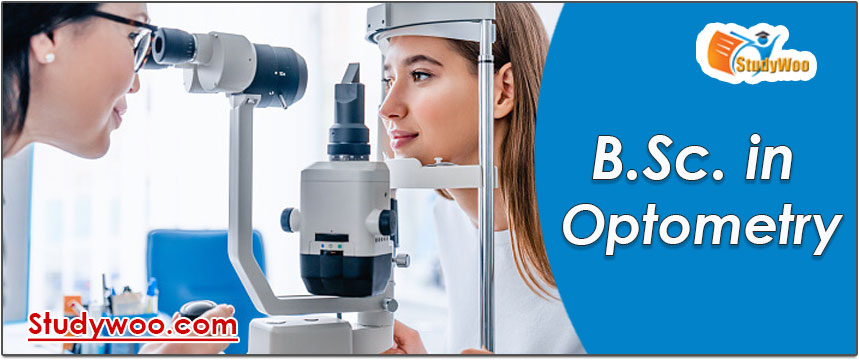
- It is most important to note that, it is a 4 years long UG level Science course.
- This is to point out that, the academic program is 3 years long.
- It is most important to note that, the academic course is followed by a 1-year internship program.
- After that, the students will get the Degree and will be a qualified Optometrist.
- This is to point out that, the candidate should have passed 10+2 in the science stream.
- Besides, they should also have subjects like Physics, Chemistry, Biology, and English.
- It is most important to note that, at least 45% of marks is required.
- However, it may vary from one institute to another.
If you are a student willing to become an Optometrist or an Ophthalmologist, you should know that you are going to learn in the Bachelor of Optometry (B.Optom.) course.
- Human Anatomy and Physiology
- Basic Biochemistry
- Ophthalmic Optics
- Ocular Microbiology
- Optic Dispensation
- Geriatric Optometry
- Pediatric Ophthalmology
- Visual Optics
- Optometric Instruments
- Mechanical Optics
Admission process
- This is to point out that, admission is based on marks scored by candidates in board exams.
- It is most important to note that, state or relevant entrance test scores are also taken into account.
- This is to point out that, students who have completed 2 years Diploma in Optometry course can also get admission directly in 2nd year of B.Sc. Optom.
- Besides, it is also known as lateral entry.
Diploma in Optometry
- It is most important to note that, the duration of this course is 2 years.
- However, in some institutes, it is 3 years.
- This is to point out that, D.Opt holders may also make lateral entry and join 2nd year of course.
- It is most important to note that, D.Opt course is highly job oriented.
- Besides, Bachelor’s Degree courses help one to succeed in one’s career.
- This is to point out that, this course is also known as the Ophthalmic Technology course.
Eligibility criteria
- It is most important to note that, the candidate should have passed the 10+2 exam. The candidates who have completed their 10+2 education from the science stream with compulsory subjects such as Biology, Physics, and Chemistry are only eligible for admission to Diploma in Optometry course.
- However, few institutes allow admission to 10th pass students as well.
- At least 45% of marks is required.
- However, this varies from one institute to another.
Admission process
It is most important to note that, few universities also allow direct admission.
Some colleges and universities conduct entrance examinations such as AMUEE, AIIMS EE, etc. to provide admission to the Diploma in Optometry course. Based on the entrance examination score, a merit list is prepared and students are selected.
Certificate Courses
- This is to point out that, the certificate courses are not important.
- However, they will help candidates to get technical and assistants’ jobs in the eye care sectors.
- It is most important to note that, these courses last for 1 year.
- This is to point out that, candidates should be 10+2 pass from a recognized board.
- However, some colleges also offer certificate courses to 10th pass candidates.
- Most students who aspire to take up a job at the earliest opt for the certification courses as they get completed in a short period and get numerous benefits.
- The students must note that admission to the Optometry course is done based on the marks obtained at the secondary level which is the 10th standard.
- Certification courses are beneficial for students who want to acquire skills. Some of the certification courses are mentioned below.
- Cataract Courses
- Low Vision Aids
- Contact Lenses
- Speciality Contact lenses
- Anterior and Posterior Segment Investigations
Core Subjects of Optometry
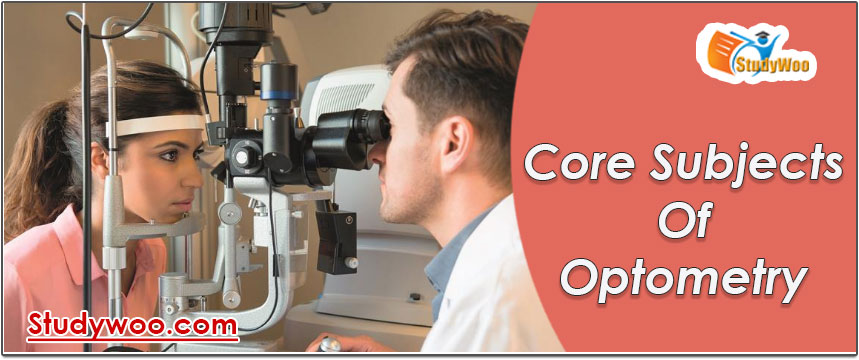
Let’s look at the core subjects:
- Ocular Anatomy
- Ocular Physiology
- Pharmacology
- Microbiology
- Pathology
- Visual Optics
- Ocular Diseases and Conditions
- Dispensing Optics
- Optometry Instruments
- Contact Lenses
- Community Optometry
- Hospital Training
It is most important to note that, most of the subjects mentioned above have both theories as well as practical lab sessions.
This is to point out that, in the case of Bachelor’s Degree courses, the duration is 1 year.
However, there is also an internship program is conducted at the end of the course. The internship program provides the students with hands-on training. The students gain practical knowledge related to the various aspects of optometry.
Skills Required for Optometrist
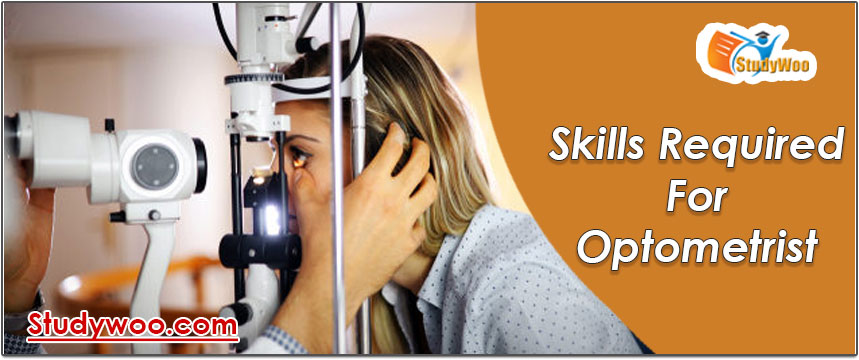
- This is to point out that, optometrists examine and diagnose specific eye-related disorders.
- Besides, they also manage injuries and problems of the visual system.
- Moreover, they also counsel and prepare clients for both surgical and non-surgical treatment.
- Let’s look at the skills required:
- It is most important to note that, the optometrist has to be patient with the clients.
- There is a rush of patients in the hospital and clinic. Patience is very much essential to ensure proper allocation of treatment.
- This is to point out that the optometrist has to be confident in their approach.
- It is most important to note that, the optometrist must be self-disciplined.
- Self-discipline helps in setting a proper schedule of time and hence avoids confusion in the work.
- This is to point out that, the optometrist must be careful while handling patients.
- Optometry is a delicate stream. The optimist needs to manage the patients effectively.
- It is most important to note that, the optometrist must be persistent and dedicated.
- This is to point out that, the optometrist must have a serving nature.
- It is most important to note that, The optometrist must know how to work with other doctors, optometrists, etc. A strong sense of teamwork is required in an optometrist.
Duties and Responsibilities of Optometrists
- Firstly, to do vision tests and report the results
- Secondly, to diagnose eye problems and diseases
- Thirdly, to prescribe visual aids for the clients such as contact lenses and eyeglasses
- Besides, to assist in minor surgeries to correct and treat eye problems and diseases
- Moreover, to provide treatments such as vision therapy and vision rehabilitation.
- Besides, to offer pre and post-operation care for the patients.
- Moreover, to evaluate patients for any other diseases such as hypertension, diabetes, etc.
- Besides, to counsel patients to take good care of their eyes.
Optometry Course Fees after 12th
- This is to point out that, for the Bachelor’s degree course in optometry in the Indian private universities, the fees is nearly Rs. 2.5 to Rs. 4 Lakh per year.
- Besides, for the diploma course, fees are between Rs. 2 and 2.5 lakh per annum.
- It is most important to note that, for a Master’s degree, the fee is Rs 4 Lakh to Rs.6 lakhs per year.
- The students can also take up internship programs in various hospitals.
- When the students start doing an internship in the field of Optometry, they get to know about various aspects practically. They get hands-on training and can implement what they have learned in the curriculum of the optometry course.
Top colleges for Optometry Courses in India
This is to point out that, Optometry is also offered as a para-medical course in many governments and private colleges in India.
Let’s look at the top colleges in India offering this course. These colleges are famous and the best in India. The fees for Optometry Courses in top colleges range from INR 19,000 to INR 94,000. The placement opportunities are extremely satisfactory as students get a great career edge.
- All India Institute of Medical Sciences, Delhi
- Christian Medical College, Vellore
- SRM University, Chennai
- JIPMER, Pondicherry
- Sri Ramachandra institute of higher education, Chennai
- Jamia Hamdard University, New Delhi
- Bharati Vidyapeeth University
- Government Medical College, Nagpur
- Punjab Medical College, Amritsar
- Medical College, Patiala
- Birla Institute of Tech. Science, Pilani
- All India Management Association
- Government Medical College and Hospital, Surat
Top Universities for Optometry Courses Abroad
Let’s have a look at the list consisting of top universities’ Optometry Courses in foreign countries.
- University of Bradford, UK
- University of Western Australia
- University of New Orleans, USA
- Western New England University, USA
Popular Job options after Optometry Courses
- This is to point out that, optometry is a challenging and dynamic healthcare field.
- It is most important to note that, it involves the measurement of vision and diagnosis of underlying health problems.
- Besides, it also deals with prescribing lenses to enhance vision.
- This is to point out that, it also focuses on diagnosing and the treatment of various eye diseases.
- Besides, after completing three years of B.Sc. Optometry course, the students can find jobs in eye care clinics, eye care departments.
- Moreover, they can also get jobs in optical showrooms, lens manufacturing units, health care sectors, etc.
- Besides, most of the optometrist are employed in hospitals and primary health care centers to treat eye problems of people.
- This is to point out that, they also offer counseling and rehabilitation services.
- Besides, some optometrists also work as postsecondary teachers in colleges.
- Moreover, some also research optometry and work as consultants in the eye care products companies.
- This is to point out that, an optometrist is an independent primary health care provider.
- It is most important to note that optometrist is medical professionals, but not physicians.
- This is to point out that, they focus on regular vision care and also prescribe eyeglasses and contacts.
- It is most important to note that, an optician is also an important part of the eye care team, but he is not an eye doctor.
- Besides, an optician uses a prescription, written by an optometrist or an ophthalmologist.
- Moreover, the optician is also trained to design, verify fit eyeglass lenses and frames, contact lenses, and other devices to correct eyesight.
- Besides, an Ophthalmologist can do private practice, as a solo practitioner or be part of a medical group.
- Moreover, an Ophthalmologist can also work as a public health employee, a professor in medical universities.
- Besides, they can also work as a military doctor, an employee of a clinic, hospital & government agencies.
Optometry Courses Top careers
Let’s look at the most popular careers. If you go into the Optometry field, you can become anyone of the following. You can expect a good salary from these positions. The only requirement is that you have to be skillful and expert in your field.
- Customer Care Associate
- Private Practitioner
- Professor
- Trainee Optometrist
- Vision Consultant
- Optometry Researcher
Future Prospects
- This is to point out that, optometry is a promising course.
- Besides, it is also job oriented for all candidates.
- Moreover, job options for these courses are expected to grow by up to 17% in the next ten years.
- This is to point out that, it is much faster than all other occupations.
- Students who take up an internship program after graduation have a better chance of getting jobs. Internships provide you with better learning opportunities in the field of optometry.
- Moreover, it enhances their job prospects, as eye institutes offer jobs for experienced candidates.
- This is to point out that, they can also work in the eye specialty department of a hospital.
- Besides, they can also work as community optometrist, researcher, and domiciliary optometrist as well.
Hence, this profession is all about helping people to see properly and take good care of their eyes.
Salary of Optometrist
The starting salary of an optometrist ranges between 20k to 40k. Fresher optometrists can also earn Rs 4 lacs to 5 lacs per year. Salary may differ according to their job location and skills. The salary package in India ranges between 9 to 10 lacs per year.
Salary offered, job opportunities as a optometrists all of these basic details are made clear above. Let’s quickly have a look on some of the basic advantages of doing optometry courses. After completing optometry course you have various job opportunities not just that but if you wish you can also continue with higher studies in the same field. There are high chances that you can be your own boss. Compared to the job offered in other career fields the job offered here is less stressful. As a optometrist you get a Clean and well-structured work environment where it becomes very comfortable to work.
Ans. That is to say, Optometry is a full-time 3-year UG course. Besides, it is divided into six semesters, of six months each. However, it essentially involves an advanced study of the clinical skills relating to eyesight. Moreover, it also involves professionally measuring eyesight, prescribing corrective lenses, and detecting eye diseases.
Ans. To clarify that, Optometry is the science of eye care. Besides, it also includes eye examination, diagnosis. Moreover, it also focuses on the treatment and management of diseases and disorders of the visual system. Besides, it is a vision care science.
Ans. To point out that, the graduates can manage any optical related trade including primary dispensing of spectacles. Moreover, they can also deal with professional education in optometry. However, one can start one’s eye clinic, optical shop, lens manufacturing unit, etc.
Ans. To clarify that, to complete an optometry degree, it takes seven-to-nine years. Besides, 3 – 4 years of college. Moreover, four years of optometry school. Besides, a one-year clinical residency for specialization.
Ans. That is to say, Optometry is a good career for many reasons. Moreover, it is a profession that is still in high demand. Besides, there is a lot of scope in, low vision practice, developmental optometry or binocular vision, pediatrics, geriatrics, etc.
Ans. To clarify that, for optometry, you need not give or qualify NEET. However, students who want to do degree or diploma courses in ophthalmic technology should be 10+2 pass with a minimum of 50% marks in physics, chemistry, and biology.
Ans. To point out that, Optometrist is a Doctor of Optometry (OD). However, an Ophthalmologist is a Doctor of Medicine (MD). Moreover, EYECET is the centralized entrance test for entry. Besides, admissions are done as per entrance exam
Ans. That is to say, optometry has some stress associated with it. However, if you are passionate about serving people, you will enjoy this profession. Moreover, it is stressful because you have to spend more time on work serving people. Besides, you often have to handle critical cases.
Ans. To point out that, to become Optometrists, you should have completed a 4-year bachelor’s degree program. Besides, it should be in the relevant field such as biology, chemistry, or physiology. Moreover, you require a bachelor’s degree to apply for optometry programs.
Ans. To clarify that, admission to B.Sc. Optometry course is provided to eligible candidates. Moreover, based on performance in a relevant entrance exam. Besides, this exam is conducted either by the concerned institution or at the State or national level.
About: Optometry is a health care profession that involves examining the eyes and applicable visual systems for defects or abnormalities as well as prescribing and selling of the correction of refractive error with glasses or contact lenses and management and treatment of some eye diseases.


